
What a Clogged Drain Looks Like, Fixture by Fixture
Each fixture tends to collect its own kind of debris, so the symptom often hints at the cause. Use this comparison to describe what you are seeing when you call.
| Fixture | Common symptom | Usual culprit |
|---|---|---|
| Kitchen sink | Slow draining, water backing into the second basin, a sour smell | Grease, food scraps and soap that harden along the pipe wall |
| Bathroom sink | Water pools around the stopper and drains in a thin stream | Hair, toothpaste and soap scum caught at the pop-up or trap |
| Tub or shower | Ankle-deep water during a shower that slowly disappears | Hair combined with soap residue in the drain or trap |
| Toilet | Bowl fills high, then drains slowly; frequent plunging | Excess paper, wipes or a foreign object in the trapway |
| Laundry standpipe | Water spills from the standpipe during the drain cycle | Lint and fibers, or a line too restricted to handle the pump's flow |
One Slow Fixture or Several Backing Up?
This is the single most useful question in drain diagnosis. The answer tells us roughly where in your plumbing the restriction sits.
Only one fixture is slow
The clog is most likely in that fixture's trap or the short branch line connecting it to the rest of the system. These are usually cleared at the fixture itself.
Several fixtures are affected
When a toilet gurgles while the shower drains, or water appears in a tub after running the washer, the blockage is probably further downstream where those lines join.
Fixtures on the lowest level of the home are usually the first to show a downstream problem, because water finds the lowest available opening. If a ground-floor tub or shower fills with water you did not run, treat that as a sign of a main line issue rather than a local clog.
How We Clear a Drain
Drain clearing is not one technique. The right method depends on the fixture, the pipe size and material, the access point and what is causing the blockage.
Confirm the scope
We run water at nearby fixtures to see which ones are affected and locate the best access point, whether that is the fixture, a trap, or a cleanout.
Clear the line mechanically
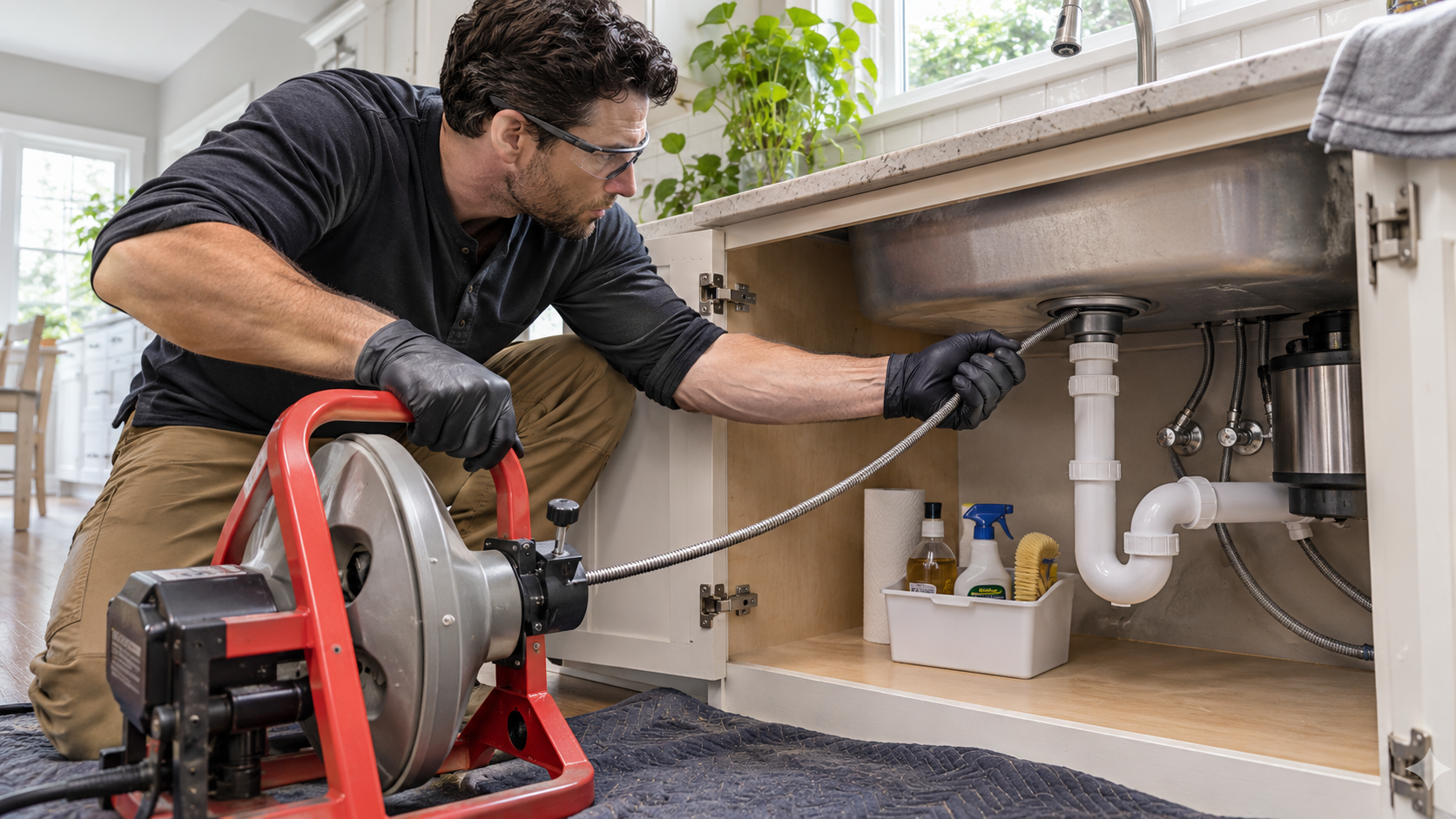
For most clogs, a drain cable or auger sized to the pipe is used to break up and remove the blockage. Small fixture lines and larger branch lines call for different equipment.
Test the flow
After clearing, we run water at volume to confirm the line drains freely and that other fixtures on the same branch are no longer affected.
Explain what we found
What came out of the line, and how far in the clog was located, often tells us whether this was a one-off or a sign of something larger.
We generally advise against pouring chemical drain openers into a line that is fully blocked. They can sit in the pipe, may be hard on older piping and seals, and make the work area less safe for anyone who has to open the line afterward.
When a Camera Inspection Makes Sense
Most single clogs do not need a camera. But when the same drain clogs again within weeks or months, guessing becomes expensive. A camera inspection of the line can show whether there is heavy buildup along the pipe walls, a sag where water and debris settle, a damaged or offset section, or root intrusion.
We may recommend a camera look when:
- The same line has needed clearing more than once in a short period.
- The cable brought back roots, soil, or pieces of pipe.
- The clog was located well beyond the fixture, out toward the main line.
- You are planning a remodel and want to know the condition of the drains first.
When a Drain Problem Becomes a Sewer Problem
Some findings point beyond the drains inside the house. If several fixtures back up together, if sewage appears in a floor drain or shower, or if inspection reveals roots, a collapsed section, or a break in the main line, the next step is a closer look at the main drain and lateral. Our sewer line repair page explains how that evaluation works.
Drain care is just one part of our residential plumbing services for Laguna Niguel households, and the same source-first approach applies to every call.
Same drain clogging again?
Tell us how often it happens and which fixtures are involved.
Drain Cleaning FAQs
Why does my drain keep clogging every few months?
A recurring clog usually means something in the line keeps catching debris. Common reasons include grease buildup that narrows the pipe, a low spot where water sits, a rough or damaged section, or roots entering through a joint. Clearing the line restores flow, while a camera inspection can show which of these is the underlying cause.
Are kitchen drain clogs different from bathroom drain clogs?
Yes. Kitchen clogs are mostly fats, oils and food particles that cool and stick to the pipe, often further down the line. Bathroom clogs are usually hair and soap close to the fixture. That difference affects where we start and which equipment we use.
Should I stop using the fixture until it is fixed?
If water is backing up or overflowing, yes. If several fixtures are affected, limit water use throughout the house, because running a shower or washer can push water out at the lowest drain. A single slow sink can usually be used lightly until the visit, as long as it is not overflowing.
Is a plunger safe to try first?
For a simple toilet or sink clog, a plunger is a reasonable first try. Stop if it does not work after a few attempts, or if water starts appearing in other fixtures. That suggests the blockage is further down than a plunger can reach.