
Toilet Troubleshooting
Toilets are simple machines, which makes their problems fairly predictable. Here is what each common symptom usually means.
Toilet
Tank & bowl- Running toilet
- Water keeps flowing into the bowl after a flush. Usually a flapper that no longer seals, a chain that holds it open, or a fill valve set too high so water spills into the overflow tube.
- Refills by itself
- A short refill every so often with no one using it. Water is slowly seeping from the tank into the bowl, most often past a worn flapper.
- Weak flush
- Possible causes include a low tank water level, a flapper closing too early, mineral buildup in the rim holes, or a partial clog in the trapway or drain.
- Water at the base
- Could be a failed wax ring seal, loose closet bolts, a leaking supply line, or condensation on the tank. Identifying which matters before anything is replaced.
- Rocks or shifts
- A loose toilet can break the seal at the floor. It should be reset on a new seal rather than just tightened, especially if the floor shows signs of moisture.
Faucet Leak Repair
Faucet problems depend heavily on how the faucet is built. Compression, cartridge, ball and ceramic disc faucets each use different seals, so the brand and style guide the repair.
Faucet
Kitchen, bath & tub- Dripping spout
- Worn washers or seats on compression faucets, or a worn cartridge, O-rings or disc seals on single-handle designs.
- Leak at the handle
- Usually a worn O-ring or packing around the stem or cartridge.
- Low flow at one faucet
- Often a clogged aerator or debris in the cartridge, rather than a whole-house pressure problem.
- Stiff or loose handle
- Mineral buildup or a worn cartridge or ball assembly.
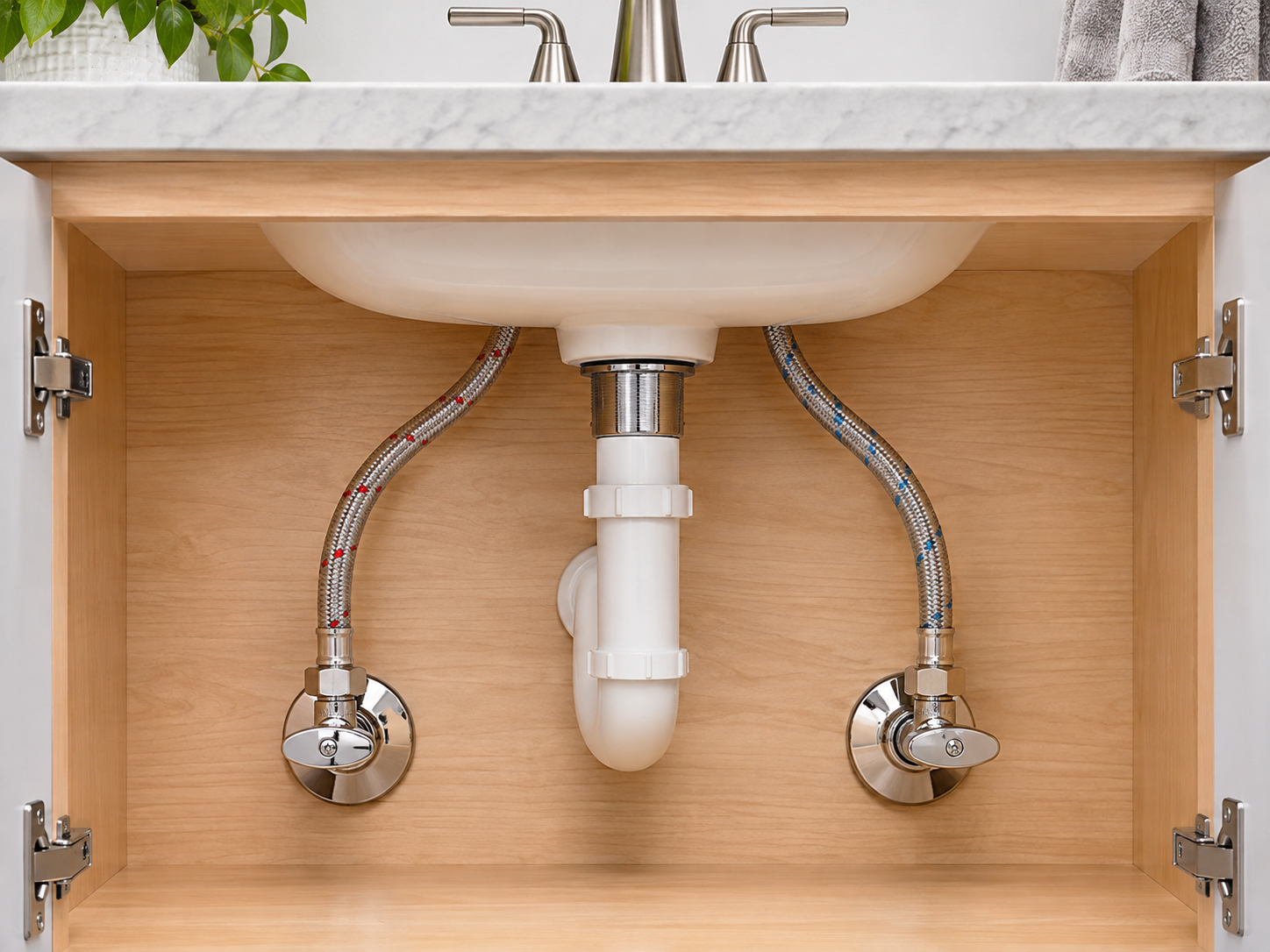
Under-Sink Supply Lines and Shutoffs
The parts under the sink are easy to forget until one fails. Braided supply lines can wear or bulge with age, and compression fittings can loosen. Shutoff valves that have not been turned in years may seize, or start leaking at the stem the moment someone tries to close them.
- A drip forming at the nut where the supply line meets the valve or faucet.
- A supply line with a bulge, kink, or visible fraying.
- A shutoff valve that will not turn, or will not fully stop the flow.
- Water stains or swelling on the cabinet floor.
Replacing worn supply lines and stuck shutoffs during a faucet or toilet visit is often practical, so you can isolate that fixture quickly in the future.
Repair the Part or Replace the Fixture?
Repair usually makes sense when
The fixture body is sound, parts are available for that brand and model, and the problem is a single worn component such as a flapper, fill valve, washer or cartridge.
Replacement may be better when
Parts are discontinued or hard to match, the fixture is cracked or badly corroded, several parts are failing at once, or you want a different style, height or water use.
Compatibility matters. A replacement cartridge has to match the faucet exactly, and a new toilet needs the correct rough-in distance from the wall. We confirm these before recommending either route.
When It Is Not Really a Fixture Problem
Sometimes the fixture is just where a bigger issue shows up. A toilet that clogs repeatedly, or gurgles when other drains run, may point to a downstream blockage covered on our drain cleaning page. A stain on the ceiling below a bathroom, or water that keeps appearing with every fixture dry, may mean a hidden leak, which our leak detection page explains.
Fixture repairs are part of our home plumbing work across Laguna Niguel, and we will tell you if what we find points somewhere else.
Hear the toilet running at night?
That is usually a quick fix, and worth doing soon.
Toilet & Faucet FAQs
Is a running toilet really wasting much water?
It can be. Because a running toilet flows continuously, even a small leak past the flapper adds up across days and weeks, and it often shows up on the water bill before anyone notices the sound.
Why is there water around the base of my toilet?
The most common causes are a failed wax ring seal, a loose toilet, a leaking supply connection, or condensation dripping from the tank. Each has a different fix, so we confirm the source first.
Can you match a part for an older faucet?
Often, yes, if the brand and model can be identified. If parts are no longer available, we will explain the replacement options that fit your sink or counter.
My toilet flushes weakly even after plunging. What now?
If plunging restores normal flow only briefly, check whether the tank fills to the line marked inside it. A low water level or a flapper that drops too soon reduces flushing force. If the tank looks right, the restriction may be in the trapway, in the rim jets, or further down the drain, and those are worth having looked at.
How do I shut off water to a single fixture?
Most toilets and sinks have small shutoff valves on the supply lines underneath or behind them. Turning the handle clockwise closes the valve. If it will not turn, do not force it; a stuck valve is worth replacing during a repair visit.